Globalisation’s impact on Higher Education
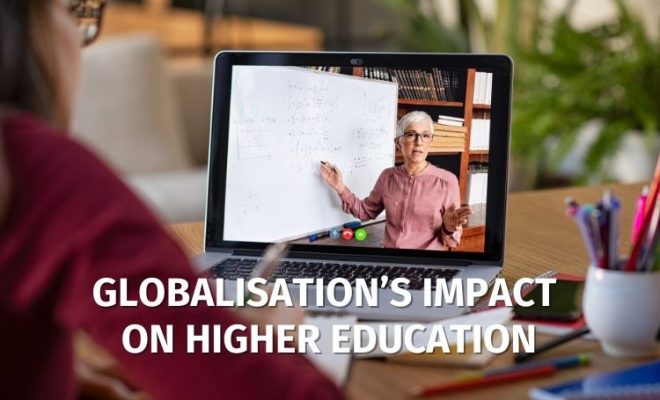
Globalisation drives higher education and higher education is driven by globalisation. This phenomenon of increasing worldwide interconnectedness, combining changes at three levels – economic, cultural and social changes. Through higher education, workers are trained to become more skilled to contribute to research, make innovations thereby increasing the competition in the knowledge-based global economy.
In 2009, there was a concern about how higher education and research might look in the future. Will there be a move from national models to an adoption of global ones, as has been seen in many business schools already?
The effects of globalisation have been far-reaching. Around the world transformation is taking place drastically in all sectors. In Higher Education, globalisation covers international and collaboration between teaching and research, networking that is purpose-specific and generic; and global recruitment of teaching staff and students. We see mobility of students and faculty, institutions and programmes as higher education crosses borders.
In the 1990’s students could play low-resolution games on the standalone PCs in school. Today students indulge in iPads, laptops at home as well as in school. Face-to-face learning is replaced with tablet-based learning. The art of writing is slowly dying, along with library research skills of going to the library and browsing the Encyclopaedia. No school project is complete without browsing the internet. The catch phrase for today is “Google it”.
In earlier days learning was nearly the same in schools worldwide. Students sat passively listening to the teacher, taking notes and doing their tests and exercises. Education today has gone beyond the confines of a classroom. “Generation WiFi” was born, where the younger generation is brought up using technology, thus changing the way they learn. Education has moved from blended to hybrid and the COVID-19 pandemic has greatly disrupted schooling in the world.
Covid-19 turned many cities into phantom cities and this effect was seen in schools, colleges, and universities too. From blended learning approach of synchronous and asynchronous learning and independent learning, now teaching and learning is in the virtual medium.
The objective of this continuum is that by introducing Information and Communications Technology (ICT) to deliver a programme, learning in institutions have moved beyond traditional face-to-face traditional approach to an ‘E-intensive’ approach. Understanding the need of the situation, globally universities understood the dire need of the current situation and digitalised their operations. In the midst of this chaos online learning emerged as a victor.
In the world, the need of the hour for many education systems became online learning. As educators had no choice but to adapt to online learning, the disdain for online learning diminished sharply. This left teachers with little or no time to debate. While some were more competent than others, it became mandatory for teachers to learn to operate the tools. Nonetheless these competencies paved the way for pedagogical advancement giving teachers a better sense of what technological tools can do and cannot provide.
Overall, as globalisation is a concept that is here to stay, it is continuously altering a world to which we have to adapt. Today the city has become a classroom whether you are in Singapore, UK, Denmark or the United States.
With globalisation of education, teaching methods are now more interrelated and ubiquitous. As access to schools intensifies students are becoming increasingly prepared for multinational roles. This enables students with a more holistic understanding of how the global business scene works thereby encouraging their active participation in it. In most cases the greatest impact on the development of a student is their capability to survive in this challenging environment, which might become for many of them the new university, workplace and the new city.
This article is contributed by Ms Margaret Pereira from the School of Languages and Education.
References:
Dhawan, S. 2020. Online Learning: A Panacea in the Time of COVID-19 Crisis
https://doi.org/10.1177/0047239520934018
Driesen, G. 2016 “We shouldn’t force those students to learn the same wa we did 10 years ago” https://www.anewspring.com/blended-and-hybrid-learning/
Jones, N, Chew, E, Jones, C & Lau, A 2009, ‘Over the worst or at the eye of the storm?’, Education+ Training, vol. 51, no. 1, pp. 6-22.
Midgley, J. 2007. “Perspectives on Globalization, Social Justice and Welfare,” The Journal of Sociology & Social Welfare: Vol. 34 : Iss. 2, Article 3. Available at: https://scholarworks.wmich.edu/jssw/vol34/iss2/3
Ng, P.T., 2020. Timely change and timeless constants: COVID-19 and educational change in Singapore. Educational Research for Policy and Practice. doi:10.1007/s10671-020-09285-3
Papadopoulou, P. 2018. The Effects of Globalisation on Education. https://www.ool.co.uk/blog/the-effects-of-globalisation-on-education/
Rooijen, M.V. 2021. Higher Education and the ‘vision thing’: looking back ten years. Global University Systems