MDIS Blog

Main Menu

MENUMENU
  • Home
  • Topics
        • Business & Management
        • Career Management
        • College
        • Engineering
        • Event
        • Fashion & Design
        • Health & Nursing
        • Information Technology
        • Languages
        • Life Sciences
        • Lifestyle
        • MDC
        • Media & Communications
        • Psychology
        • Safety Management
        • Tourism & Hospitality
        • Uncategorized
  • Campus
  • Student Life
  • Preview Sessions
  • + Become A Contributor

logo

Header Banner

MDIS Blog

MENUMENU
  • Home
  • Topics
        • Business & Management
        • Career Management
        • College
        • Engineering
        • Event
        • Fashion & Design
        • Health & Nursing
        • Information Technology
        • Languages
        • Life Sciences
        • Lifestyle
        • MDC
        • Media & Communications
        • Psychology
        • Safety Management
        • Tourism & Hospitality
        • Uncategorized
  • Campus
  • Student Life
  • Preview Sessions
Psychology
Home›Psychology›Four Types of Suicides

Four Types of Suicides


By MDIS
30th March 2020
75255
10

In today’s society, the number of suicide cases is becoming increasingly common due to the increased stress individuals face. We, are taking the term “Suicide” too liberally without understanding that suicide itself has different reasoning and intent behind the action. 

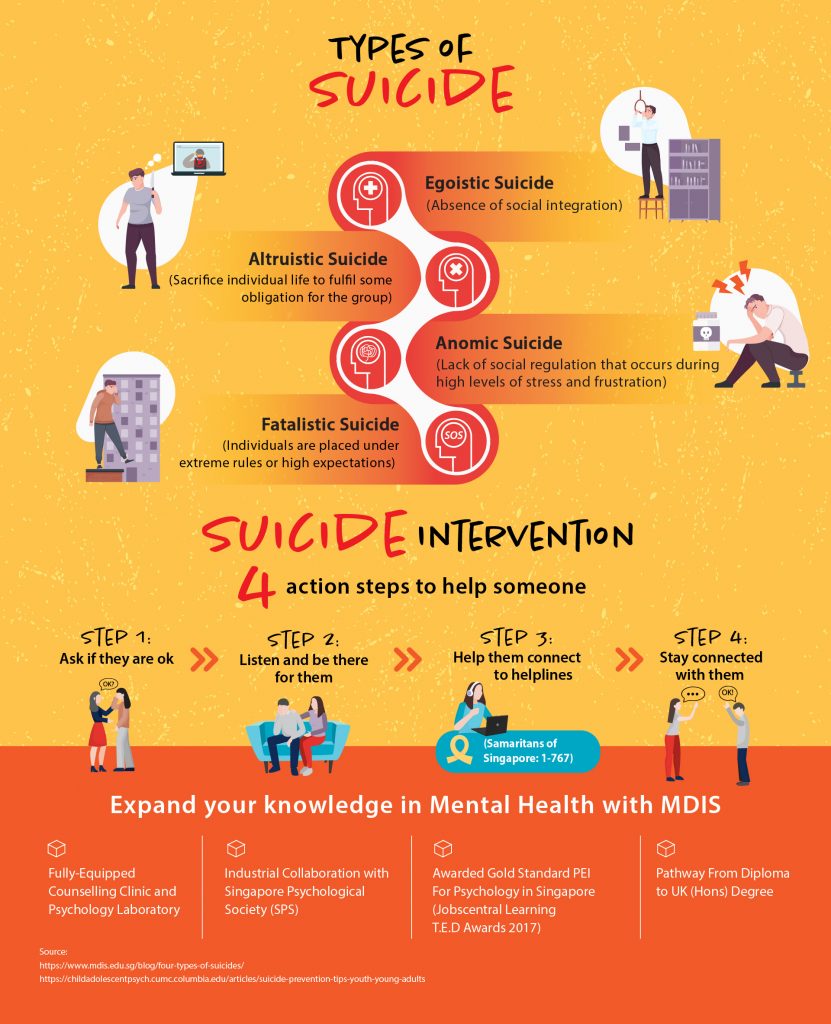
According to Emile Durkheim, the term suicide is applied to all cases of death resulting directly or indirectly from a positive or negative act of the victim, which he/she knows will produce this result (Pickering & Walford, 2011). Durkheim identifies four different types of suicide which are egoistic suicide, altruistic suicide, anomic suicide and fatalistic suicide.

Egoistic suicide is seen as stemming from the absence of social integration. It is committed by individuals who are social outcast and see themselves as being alone or an outsider. These individuals are unable to find their own place in society and have problems adjusting to groups. They received little and no social care. Suicide is seen as a solution for them to free themselves from loneliness or excessive individuation.

Altruistic suicide occurs when social group involvement is too high. Individuals are so well integrated into the group that they are willing to sacrifice their own life in order to fulfil some obligation for the group. Individuals kill themselves for the collective benefit of the group or for the cause that the group believes in. An example is someone who commits suicide for the sake of a religious or political cause, such as the infamous Japanese Kamikaze pilots of World War II, or the hijackers that crashed the airplanes into the World Trade Centre, the Pentagon, and a field in Pennsylvania in 2001. During World War II, Japanese Kamikaze pilots were willing to lay down their own lives for their countries in the hope that they will win the war. These pilots believed in their nation’s cause and were willing to sacrifice their lives. Similarly, suicide bombers around the world were willing to give up their lives in order to make a political or religious statement because they firmly believed in their group’s cause.

Anomic suicide is caused by the lack of social regulation and it occurs during high levels of stress and frustration. Anomic suicide stems from sudden and unexpected changes in situations. For example, when individuals suffer extreme financial loss, the disappointment and stress that individuals face may drive them towards committing suicide as a means of escape.
Studies conducted by the Centres for Disease Control and Prevention (CDC) have found that historically, suicides for people aged 25 to 64 rose during economic downturns (Sternheimer, 2011). There was a significant increase in suicide rates in USA from 1928 to 1932 when unemployment rates were nearly 24%. On the other hand, suicide rates were at a low in 2000 when unemployment was about 4%. In addition to economic downturns, disasters can also be associated with increases in suicide. The Japanese public health department reported that there was a rise in suicide rates after the 1995 Kobe earthquake. Earthquake survivors faced great stress and difficulty in trying to rebuild their livelihood and soon realised that their lives will not return back to normal due to the lost they suffered. Suicide became a means for them to escape reality.

Fatalistic suicide occurs when individuals are kept under tight regulation. These individuals are placed under extreme rules or high expectations are set upon them, which removes a person’s sense of self or individuality. Slavery and persecution are examples of fatalistic suicide where individuals may feel that they are destined by fate to be in such conditions and choose suicide as the only means of escaping such conditions. In South Korea, celebrities are being put under strict regulations. There was a case where, a singer committed suicide due to exhaustion to keep up with society’s rules and regulations. In 2017, celebrity Kim Jonghyun ended his life due to severe depression and the pressure of being in the spotlight as he felt that he  could not fulfil the society’s expectations  of his performance (Lee, 2018).

This article is contributed by Dr Amir Singh from the School of Psychology. 
References

Lee, J. (2018, September 8). Family of late SHINee star Jonghyun sets up foundation support young artists. Retrieved from The Straits Times: https://www.straitstimes.com/lifestyle/entertainment/family-of-late-shinee-star-jonghyun-sets-up-foundation-to-support-young

W. S. F. Pickering; Geoffrey Walford; British Centre for Durkheimian Studies (2000). Durkheim’s Suicide: a century of research and debate. Psychology Press. p. 25. ISBN 978-0-415-20582-5. Retrieved 13 April 2011.

Previous Article

Sashaying in Style at the #LevelUpwithMDIS Roadshow ...

Next Article

A life-changing experience for many – An ...

MDIS

MDIS

Founded in 1956, the Management Development Institute of Singapore (MDIS) is Singapore’s oldest not-for-profit professional institute for lifelong learning. MDIS has two main subsidiaries: Management Development Institute of Singapore Pte Ltd which oversees its Singapore academic operations, and MDIS International Pte Ltd which focuses on MDIS’ globalisation strategy. MDIS offers internationally-accredited courses in Business and Management, Engineering, Fashion and Design, Health and Nursing, Information Technology, Languages and Education, Life Sciences, Media and Communications, Psychology, Tourism and Hospitality Management, and Safety and Environmental Management.

Related articles More from author

  • Great Listener
    Featured PostPsychology

    [Infographic] What Great Listeners Actually Do

    28th February 2018
    By MDIS
  • Psychology

    Top Mental Health Challenges that Millennials & Gen Z Face Today

    27th May 2022
    By Prasheena Chettiar
  • LifestylePsychology

    Mental Health: A Key Factor Affecting your Well-being

    18th September 2023
    By MDIS
  • Psychology students
    Featured Full Width SliderFeatured PostPsychology

    Should I study Psychology? Here are the Top 6 traits of Psychology students

    12th December 2017
    By Christopher
  • ethics workplace
    Featured BK RowPsychology

    How Ethics & Morality exist in the working environment

    11th January 2018
    By Christopher
  • Work Stress
    Featured PostPsychology

    Stress and Your Addictive Behaviours

    13th April 2018
    By Anil Singh Sona

You may also like

  • Indonesia
    Featured Full Width SliderUncategorized

    4 Reasons to visit Indonesia on your next Holiday

  • Game Based Learning
    Featured Full Width SliderLife Sciences

    Game Based Learning

  • soe video
    EngineeringFeatured BK Video

    Does Building Things Shift Your Brain up a Gear?

Categories

  • Business & Management (36)
  • Campus (9)
  • Career Management (39)
  • College (17)
  • Engineering (13)
  • Event (35)
  • Fashion & Design (37)
  • Featured BK Row (64)
  • Featured BK Video (10)
  • Featured Full Width Slider (57)
  • Featured Post (88)
  • Health & Nursing (7)
  • Information Technology (33)
  • Languages (16)
  • Life Sciences (25)
  • Lifestyle (11)
  • MDC (14)
  • Media & Communications (29)
  • Pre-degree / Preparatory Courses (1)
  • Psychology (10)
  • Safety Management (9)
  • Student Life (22)
  • Think by MDIS (1)
  • Tourism & Hospitality (29)
  • Uncategorized (11)

Follow us on Instagram

This error message is only visible to WordPress admins

Error: No connected account.

Please go to the Instagram Feed settings page to connect an account.

TAGS

  • fashion
  • technology
  • cybersecurity
  • Tourism and Hospitality
  • Digitalisation
  • MDIS Events
  • career planning
  • MDIS School of Fashion and Design
  • Career Guides
  • MDIS College
  • MBA
  • cookery
  • MDIS Students
  • biomedical sciences
  • Business Administration
  • MDIS Business Club
  • MDIS Graduation Ceremony
  • Fashion Design
  • lecturer's life
  • career management
  • Lifestyle
  • MDIS
  • fashion industry
  • Artificial intelligence
  • MDIS Business School
  • Travel Guides
  • MDIS School of Tourism and Hospitality
  • Career Assistance Unit
  • engineering
  • life sciences
THINK SUCCESS. THINK MDIS.
Copyright© 2022. MDIS Blog. All Rights Reserved.
     
Where lifelong learning begins