MDIS Blog

Main Menu

MENUMENU
  • Home
  • Topics
        • Business & Management
        • Career Management
        • College
        • Engineering
        • Event
        • Fashion & Design
        • Health & Nursing
        • Information Technology
        • Languages
        • Life Sciences
        • Lifestyle
        • MDC
        • Media & Communications
        • Psychology
        • Safety Management
        • Tourism & Hospitality
        • Uncategorized
  • Campus
  • Student Life
  • Preview Sessions
  • + Become A Contributor

logo

Header Banner

MDIS Blog

MENUMENU
  • Home
  • Topics
        • Business & Management
        • Career Management
        • College
        • Engineering
        • Event
        • Fashion & Design
        • Health & Nursing
        • Information Technology
        • Languages
        • Life Sciences
        • Lifestyle
        • MDC
        • Media & Communications
        • Psychology
        • Safety Management
        • Tourism & Hospitality
        • Uncategorized
  • Campus
  • Student Life
  • Preview Sessions
Life SciencesFeatured BK Row
Home›Life Sciences›Bacterial Staining Techniques

Bacterial Staining Techniques
By Dr Sunesh
23rd January 2021
2020
0
Bacterial Staining Techniques

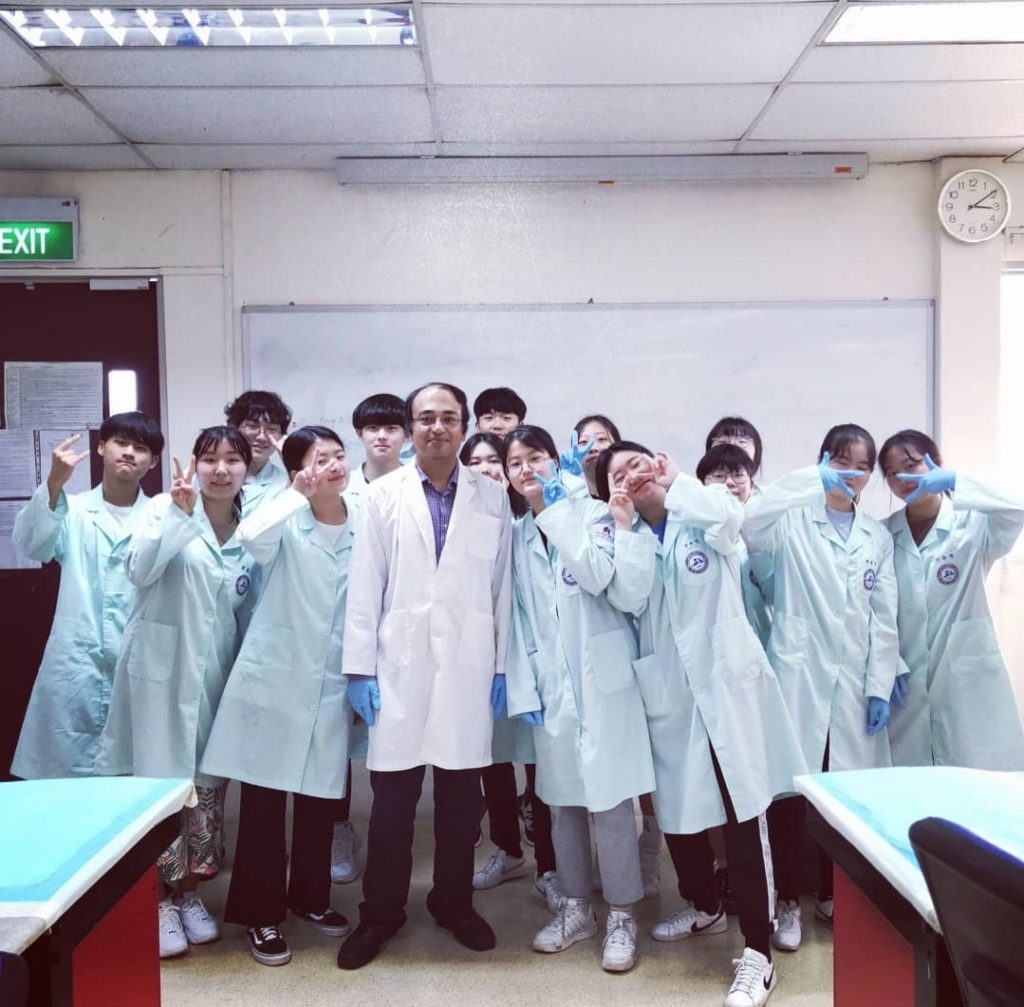
I was involved in training a group of students from the Korea Bio Meister High School on bacterial staining techniques and share my views on the various processes in identifying bacterial cells using the following techniques.  
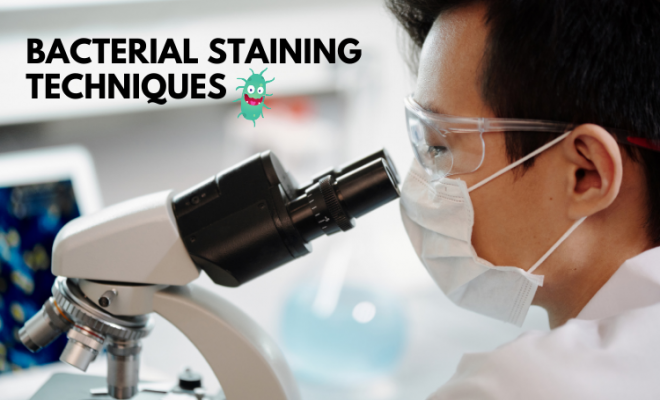
Bacterial cells are difficult to be viewed under the microscope unless they are stained. This is due to their lack of colour and contrast. Scientists have been using several types of stains to make these cells visible. The staining procedure will help researchers to identify the bacteria, as well as help healthcare providers to diagnose infections caused by bacteria. 

One basic type of staining procedure that can be used is the Simple Stain, where we use just one type of stain, and the bacteria takes up the colour of the stain, when observed under the microscope. We get to study the morphology, dimensions, cell size and arrangement in this type of staining.

Negative staining method can also be used in which the background of the bacteria takes up the stain, and the specimen is untouched, thereby creating a contrast and making the bacterial cell visible. This method is very convenient and is useful to view the overall morphology of the bacterial cell. This method is based on the principle of the repulsion between the negatively charged stain used and the negatively charged bacterial cell wall. 

However, to get more information about the bacteria we need to perform a Differential Stain. In this procedure we use more than one stain, and different bacterial cells will take up these stains as per their structural properties. It should be noted that the primary stain and secondary stain will have different colours which will allow the students to distinguish the different types of bacterial cells when they are viewed under the microscope.  Some examples of this Differential staining methods are the Gram Staining, Capsule staining and Endospore staining. The Gram staining is one of the most commonly used type of Differential stain. This method was developed by Dr Hans Christian Gram in 1884. This type of staining helps us differentiate between a Gram Positive and Gram-Negative bacteria, as they both take up different coloured stains, which is due to their cell wall properties.

The Capsule staining also comes under Differential stain. Many bacteria have capsules surrounding their cell, which makes them virulent, as these capsules help the bacteria evade the host immune system by resisting phagocytosis. Since these capsules are non-ionic, it’s very difficult to stain them using acidic or basic stains. Hence to observe them we stain the bacterial cell with a basic stain, and we stain the background and surroundings using an acidic stain. The capsule will not take up any of these stains and will appear as a clear halo surrounding the bacterial cell, whereas the bacterial cell and the background will take up the respective stains.

Another type of Differential stain is the Endospore staining. Endospores are a dormant form of bacteria formed by some species of bacteria during unfavourable conditions. In the case of the Endospore staining, we get to differentiate between the vegetative cells and endospores, as the spores and the vegetative cells take up differed coloured stains. All these staining techniques will help us in bacterial identification and characterisation.

We have to make sure that throughout the experiment the microscope lenses are kept clean. Though the staining procedures are quite simple, it requires a lot of practise by the students so that they are able to master these techniques and to get an optimally stained bacterial slide which will help them in their bacterial identification studies.

References:

Benson, H. J. (2005). Benson’s Microbiological Applications: Laboratory manual in general microbiology. Boston: McGraw-Hill Higher Education.

Cappuccino, J. G., & Sherman, N. (2014). Microbiology: a laboratory manual. Boston: Pearson Education.

Goldman, E., & Green, L. H. (2009). Practical Handbook of Microbiology. Boca Raton: CRC Press.

Previous Article

The Benefits of a Master’s Degree in ...

Next Article

Biotechnology degrees, what you can do with ...

Dr Sunesh

Dr Sunesh

Dr Sunesh K Augustine has more than ten years of full-time teaching experience. He has been with the MDIS School of Life Sciences since 2010, and teaches Microbiology, Immunology and Biodiversity modules. He has worked extensively on Actinobacteria and antifungal antibiotics, and has published his research work in peer-reviewed journals.

Related articles More from author

  • Business & ManagementFeatured BK Row

    How to choose an MBA program: Follow the ‘5 Rights’ Formula!

    17th September 2019
    By MDIS
  • MDIS Sport club
    Featured BK RowEvent

    MDIS Football and Badminton clubs participated in PSB’s inter-school tournament

    19th April 2018
    By MDIS
  • human brain
    Life Sciences

    Human mini-brains and why developmental biology is interesting

    8th May 2018
    By MDIS
  • SGTech
    Featured BK RowInformation Technology

    SGTECH Launchpad Tour

    9th April 2018
    By MDIS
  • SLSpic
    Featured BK RowLife Sciences

    Getting to know our Health and Life Science Family Member Dr. Ng Wei Ling

    7th October 2017
    By MDIS
  • Basic Cycle of Fashion Design
    Featured BK RowFashion & Design

    The Basic Cycle of Fashion Design

    27th February 2018
    By MDIS

You may also like

  • Media & CommunicationsFeatured Post

    The 12 Hours Photography Competition

  • Computing hacking
    Featured PostFeatured Full Width SliderInformation Technology

    The Truth About Hacking In Five Minutes

  • language school
    Languages

    Creative and Collaborative Skills for the 21st Century Success

Categories

  • Business & Management (43)
  • Campus (9)
  • Career Management (39)
  • College (17)
  • Engineering (16)
  • Event (35)
  • Fashion & Design (38)
  • Featured BK Row (64)
  • Featured BK Video (10)
  • Featured Full Width Slider (57)
  • Featured Post (93)
  • Health & Nursing (7)
  • Information Technology (34)
  • Languages (16)
  • Life Sciences (25)
  • Lifestyle (11)
  • MDC (14)
  • Media & Communications (30)
  • Pre-degree / Preparatory Courses (1)
  • Psychology (10)
  • Safety Management (9)
  • Student Life (22)
  • Think by MDIS (1)
  • Tourism & Hospitality (29)
  • Uncategorized (11)

Follow us on Instagram

This error message is only visible to WordPress admins

Error: No connected account.

Please go to the Instagram Feed settings page to connect an account.

TAGS

  • Digitalisation
  • lecturer's life
  • MDIS Business Club
  • Tourism and Hospitality
  • life sciences
  • cookery
  • cybersecurity
  • MDIS Business School
  • fashion
  • career management
  • fashion industry
  • engineering
  • MDIS College
  • Business Administration
  • Artificial intelligence
  • Travel Guides
  • Fashion Design
  • MBA
  • MDIS Students
  • career planning
  • Lifestyle
  • Career Guides
  • MDIS School of Tourism and Hospitality
  • Career Assistance Unit
  • MDIS
  • MDIS Events
  • biomedical sciences
  • MDIS School of Fashion and Design
  • MDIS Graduation Ceremony
  • technology
THINK SUCCESS. THINK MDIS.
Copyright© 2022. MDIS Blog. All Rights Reserved.
     
Where lifelong learning begins