MDIS Blog

Main Menu

MENUMENU
  • Home
  • Topics
        • Business & Management
        • Career Management
        • College
        • Engineering
        • Event
        • Fashion & Design
        • Health & Nursing
        • Information Technology
        • Languages
        • Life Sciences
        • Lifestyle
        • MDC
        • Media & Communications
        • Psychology
        • Safety Management
        • Tourism & Hospitality
        • Uncategorized
  • Campus
  • Student Life
  • Preview Sessions
  • + Become A Contributor

logo

Header Banner

MDIS Blog

MENUMENU
  • Home
  • Topics
        • Business & Management
        • Career Management
        • College
        • Engineering
        • Event
        • Fashion & Design
        • Health & Nursing
        • Information Technology
        • Languages
        • Life Sciences
        • Lifestyle
        • MDC
        • Media & Communications
        • Psychology
        • Safety Management
        • Tourism & Hospitality
        • Uncategorized
  • Campus
  • Student Life
  • Preview Sessions
Featured BK RowMedia & Communications
Home›Featured BK Row›Learning as an Imaginative Fantasy of Humanity

Learning as an Imaginative Fantasy of Humanity
By Dr Richard Chua
20th July 2020
1383
0
Learning as an Imaginative Fantasy of Humanity

In his book, In The Shadow of Young Girls, Marcel Proust proposed, “If we are to make reality endurable, we must all nourish a fantasy or two.” He encourages us to look at life with more courage and verve. During this time of Covid-19 pandemic, when all of us are teaching from home, I always think about my students. How are they coping? How are they feeling? More importantly, what are they imagining?

Imagination is important for any communication student. It is not just about thinking-out-of-the-box as there shouldn’t be any boxes to begin with, but being self-aware of one’s imaginations on topics, issues and arguments. Every society needs collective imaginations. Besides being constructions in the minds, they also shape our world-view and how people “look” around us. Obviously, I am not referring to physical looks but our image of them socially and emotionally.

Socially, we view everyone with coloured lenses. Our perception of others is predicated on experiences and memories we have accumulated since young. Values imparted to us from family and friends will also affect our perception of others. Understandably, we have only got our histories to tap on. Things that seem natural to us would definitely be suitable for others. We are naturally good natured people. So, it is just right for us to be nice to everybody.

Emotionally we are also very real. Sense of reality differs among people. What’s real to me might not be so for you. How do we make sense of emotional reality? This is a tough question. If I am annoyed by someone or something, that’s a very real feeling. Should I express it? Yes, it seems. However, I would suggest doing so gently with compassion. How do we go about doing so? Love yourself a little more. How do we go about loving ourselves? It is about being honest and admitting to things we have done to ourselves and to others.

Back to my initial question: What are my students imagining? I will never know. But there is one thing I am pretty sure about: They would stop imagining and feel bored after a while. The sense of getting and being bored is also an act of imagination. What’s boredom, you might ask.

Boredom is a state where one needs to face his/her own emotional self. That’s the time when we are most vulnerable and fragile. Old memories either nourish or haunt us, but most of the time, they remind us of unsettled business. These unsettled businesses need clarity. Once we have made sense of them with clarity, we would have settled them. Moving on would be a breeze. How do we make everything in front of us exciting? Have faith with our imaginations.

Here, I would like to call on Marcel Proust’s wonderful quote again: “If we are to make reality endurable, we must all nourish a fantasy or two.” Have faith in our imaginations and start fantasising.

I would like to offer my students a way or two with this. When encountering readings on my topics, imagine that you are providing wisdom to yourself and the world. Writers of the journal articles and books are working out challenging problems that lie in between love and hate; loyal and betrayal; desire and stability — just like the love relationships we have with our present and ex-partners. They make sense of the world — more for them — with deep love for human beings and humanity. Imagine that you are one of them. I do that all the time. This is the ultimate fantasy that has got me to attaining a Doctor of Philosophy. If the degree does mean something, as it would be: I am ready to share my knowledge and self-worth to the world.

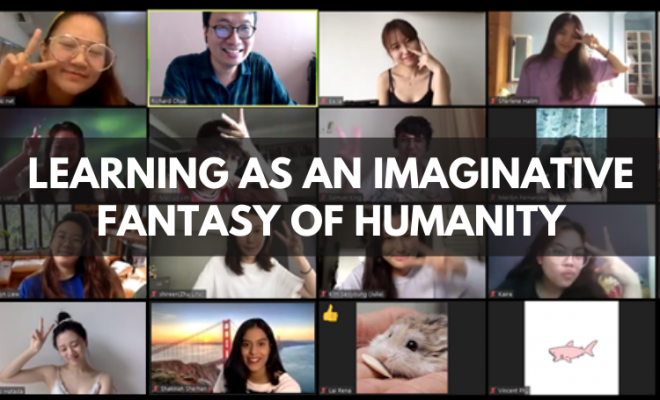
To my dear communication students, we are creating miracles every day in our Zoom classes. I look forward to seeing you soon on screen and in person.


Previous Article

8 Ways to conduct Keyword Research and ...

Next Article

The Impact Of Blockchain On Online Customer ...

Dr Richard Chua

Dr Richard Chua

As a media and arts critic, Dr Chua writes to discover knowledge within its liminal knowledge. As an educator, he delivers content to encourage constructive discussions.

Related articles More from author

  • Business & ManagementFeatured BK Row

    How to choose an MBA program: Follow the ‘5 Rights’ Formula!

    17th September 2019
    By MDIS
  • Featured BK VideoMedia & Communications

    MDIS Campus Tour

    17th May 2017
    By MDIS
  • Women Dialogue MDIS
    EventFeatured BK RowFeatured Full Width Slider

    Ageing Population: The Opportunities and Challenges for Women

    13th February 2018
    By MDIS
  • Teamwork
    Business & ManagementFeatured BK Row

    Teamwork fosters great synergy

    10th October 2017
    By MDIS
  • Featured PostMedia & Communications

    The 12 Hours Photography Competition

    19th August 2019
    By MDIS
  • Featured BK RowPsychology

    Waking World: The Iceberg is Overturned

    22nd June 2020
    By Dr. Amir Singh

You may also like

  • Why Safety Courses in Singapore Are Essential for a Secure Workplace - Compliance with Workplace Safety Regulations
    Safety Management

    Why Safety Courses in Singapore Are Essential for a Secure Workplace

  • fashionrunway
    Fashion & DesignFeatured Full Width SliderFeatured Post

    Social Media on the Fashion Runway for the millennials

  • EventFeatured Post

    COVID-19 Precautionary Measures at MDIS

Categories

  • Business & Management (36)
  • Campus (9)
  • Career Management (39)
  • College (17)
  • Engineering (13)
  • Event (35)
  • Fashion & Design (37)
  • Featured BK Row (64)
  • Featured BK Video (10)
  • Featured Full Width Slider (57)
  • Featured Post (88)
  • Health & Nursing (7)
  • Information Technology (33)
  • Languages (16)
  • Life Sciences (25)
  • Lifestyle (11)
  • MDC (14)
  • Media & Communications (29)
  • Pre-degree / Preparatory Courses (1)
  • Psychology (10)
  • Safety Management (9)
  • Student Life (22)
  • Think by MDIS (1)
  • Tourism & Hospitality (29)
  • Uncategorized (11)

Follow us on Instagram

This error message is only visible to WordPress admins

Error: No connected account.

Please go to the Instagram Feed settings page to connect an account.

TAGS

  • fashion
  • MDIS Business School
  • Digitalisation
  • MBA
  • lecturer's life
  • MDIS School of Fashion and Design
  • Career Guides
  • cookery
  • engineering
  • cybersecurity
  • life sciences
  • technology
  • MDIS Events
  • Travel Guides
  • MDIS Business Club
  • Artificial intelligence
  • career planning
  • Tourism and Hospitality
  • MDIS Students
  • Lifestyle
  • career management
  • MDIS School of Tourism and Hospitality
  • MDIS College
  • Fashion Design
  • Career Assistance Unit
  • MDIS Graduation Ceremony
  • fashion industry
  • MDIS
  • biomedical sciences
  • Business Administration
THINK SUCCESS. THINK MDIS.
Copyright© 2022. MDIS Blog. All Rights Reserved.
     
Where lifelong learning begins