The Timeline of Antibiotics
An antibiotic is a substance having the ability to inhibit or kill microorganisms, with a specific mode of action. They are credited with saving many lives, and curing many infectious diseases, which were once considered incurable or impossible to treat.
Pre-antibiotic age
During the pre-antibiotic era there was always an urgent and vital need for the development of new therapeutic agents. Experimental antimicrobial therapy was practiced for many centuries 1. There has been use of molds, fermenting bread and several forms of yeasts for treating various abdominal and gynecological ailments. Mouldy bread was used to treat open wounds, as it was considered as a remedy due to the growth of antibiotic producing microbes on them 2. Phenolic substances and mercury salts were also used for therapy inspite of their toxicity 3. In 1867, Joseph Lister, a surgeon, had proposed disinfecting both, the area around the wounds and surgical instruments, by using five percent solution of carbolic acid 4. Paul Ehrlich’s team discovered Salvarsan, in 1909, which was active against syphilis. Ehrlich had the idea of developing compounds which could specifically target the pathogenic microorganisms, and not the host cells. He used the term “Magic Bullets” for such compounds 5. This no doubt gave the scientists the concept of targeted therapies. The principle of specific development of drugs and universal standardization of diagnostic and therapeutic approaches are based on the pioneering research of Paul Ehrlich and his colleagues 6.
Discovery of antibiotics
New era of antibiotic began with Sir Alexander Fleming’s observation in 1928 concerning the lysis of bacteriaon a Penicillium contaminated culture plate left on his workbench. Scientists Ernst Chain and Howard Florey, in 1940, were able to isolate Penicillin. This gave a boost for future research on drug discovery among researchers. And in 1945, Fleming, Florey and Chain shared the Nobel Prize for their important roles in the discovery, research and development of Penicillin.
Selman Waksman, beginning in 1940s, was one of the principal investigators who started classical screening programmes for detection of new antibiotics, leading to the discovery of streptomycin, which could be used for the treatment of tuberculosis. His research led to the Golden Age of Antibiotic discoveries. By the mid-1950s representatives of most families of antibiotics had been discovered, including aminoglycosides, chloramphenicol, tetracycline, macrolides, rifamycins and fusidic acid. Chemists and microbiologists have come up with a variety of synthetic antimicrobial drugs, including nitroimidazol, quinolones and most antituberculous drugs 3.
Current status
We should realize that antibiotics can be used to treat bacterial, fungal and parasitic infections, and not against viral illness eg: common cold, flu virus etc. Antibiotic discovery was indeed one of the greatest and most successful achievements in medical history, but there are certain limitations like toxicity and drug resistance. Current antimicrobial agents are not effective against total range of pathogens because they may cause serious side effects and are becoming less useful because of increased resistance to them by the microorganisms. The growing incidence of drug resistant infectious diseases suggests that a major investment is needed for development of new active molecules. Development of new drug molecules with better therapeutic efficiency is essential in the treatment of diverse diseases and disorders. Continuing advancements in science, and a better understanding of human diseases will enable the researchers to develop novel antimicrobial drugs with desired activities, thereby encouraging a second “Golden Age of Antibiotics” in the near future 7.
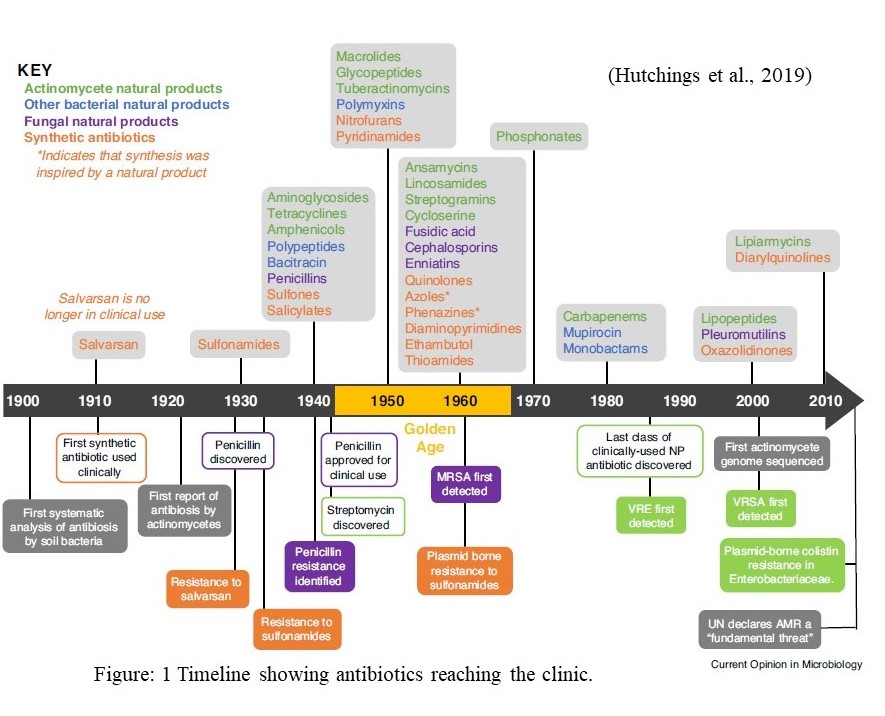
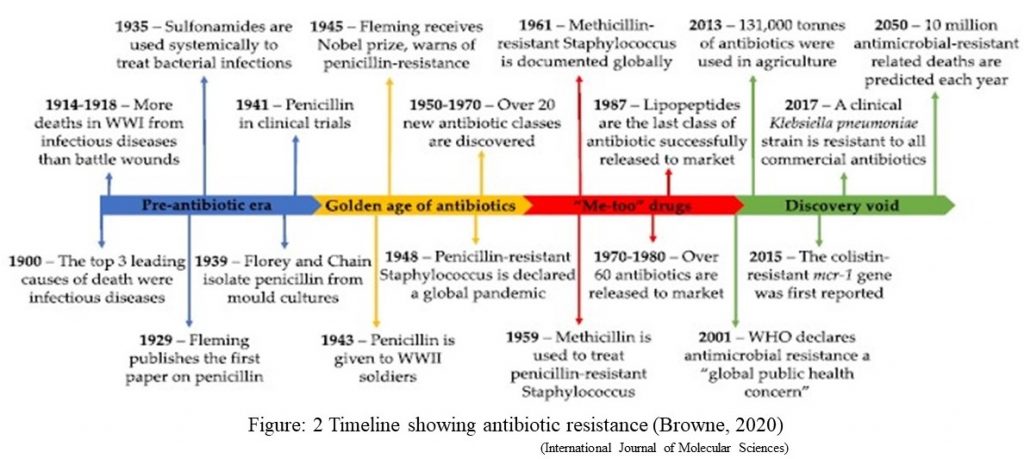
The Figure 1 shows the timeline of the antibiotics reaching clinics/hospitals 2, and Figure 2 displays the timeline showing antibiotic resistance 8.
(The article is contributed by Dr. Sunesh K. Augustine, Senior Lecturer, MDIS School of Life Sciences)
References
- John M.B., Payne E. and Berne V. Antimicrobial agents. In: The surgeons guide to antimicrobial chemotherapy. Academic Press, London, 2000, 25-66.
- Hutchings M.I., Truman A.W. and Wilkinson B. Antibiotics: Past, present and future. Curr. Opin. Microbiol. 2019, 51, 72–80
- Cai P., Kong F., Fink P., Ruppen M.E., Williamson R.T. and Keiko T. Polyene antibiotics from Streptomyces mediocidicus. J Nat Prod., 2007, 70, 215-219
- Pelczar, M. J., Chan, E. C. S., & Krieg, N. R. (1993). Microbiology : Concepts and applications. New York : McGraw-Hill.
- Aminov R. I. A brief history of the antibiotic era : lessons learned and challenges for the future. Front Microbiol. 2010 ;1 :134